
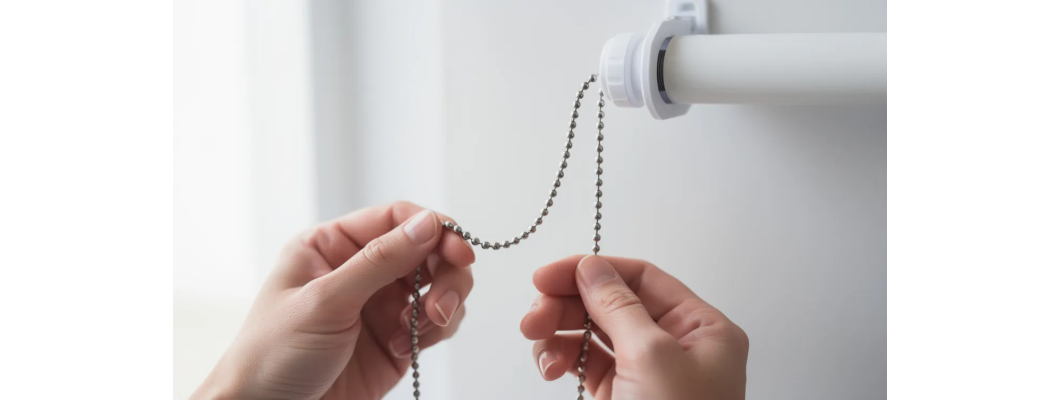
A broken or slipping roller blind chain does not always mean the complete blind needs replacing. The fault may be in the chain, connector, control mechanism or installation. Identifying the system and the damaged component is the starting point when deciding how to fix the chain on a roller blind.
We supply Silent Gliss systems and available replacement parts. This guide explains what to check before ordering and how to approach a repair without compromising the blind's safety arrangements. The instructions for your exact model take priority over general repair advice.
Understand the chain mechanism
On a chain-operated roller blind, the chain engages with a control mechanism that turns the roller tube. A damaged chain can interrupt that movement, but a worn control end or misaligned blind can produce similar symptoms.
Chains differ in material, bead dimensions, spacing and construction. A connector also needs to suit the chain and the control system. Similar-looking parts are not proof of compatibility.
Use the system number and parts diagram when choosing a replacement. Our roller blind system parts are grouped by model, including older systems where parts are listed.
Check the fault before ordering
Start with a visual inspection while the blind is securely supported in its normal position. Keep children away from a broken or unsecured chain.
Look for damaged beads, stretched links, a broken connector or a chain that has come out of its intended path.
Check that the chain safety device is present, undamaged and securely fixed.
Look for fabric rubbing against the reveal or an obstruction around the roller.
Check whether a bracket or retaining component appears loose or displaced.
Do not pull harder if the chain jams or the fabric stops moving. A chain that moves without turning the roller may indicate a control-end fault, but inspection is needed before deciding what to replace.
Do not open a mechanism or adjust an internal spring based on generic instructions. Different control ends have different service arrangements.
Identify the correct Silent Gliss parts
Find the system number
Check the original invoice, product label or installation paperwork. Photograph the complete blind, each bracket and the control end. Include any visible part numbers.
The current range and older systems can have different components. Age alone is not enough to identify a model.
Confirm the chain and connector
Check the replacement against the system's parts listing. Confirm whether it requires an endless chain, a joined chain or a particular safety connection.
Do not assume that copying the old chain length will produce a safe arrangement. The existing installation may have been altered or may be missing its original safety device. Chain length and control position must suit the manufacturer's current instructions for the identified arrangement.
Check the control end and safety components
If the mechanism is worn, replacing only the chain may leave the fault unresolved. Ask for advice before ordering where the control end is stiff, damaged or fails to engage.
We can help with product identification. Contact us with the system details and photographs so we can check the relevant parts information.
Prepare for a chain replacement
Read the fitting or service instructions before taking the blind down. They should establish whether chain replacement is a user-serviceable task and whether the roller needs removing from its brackets.
Prepare a clean surface to support the blind and protect the fabric. Use safe access equipment, and arrange assistance if you cannot support the roller securely. Keep small components organised.
If the mechanism is not designed to be opened, do not pry off its cover. A damaged retaining feature can make reinstallation unsafe.
Replace the chain using the model's instructions
Remove the roller only if required
Follow the specified release sequence for the bracket and locking components. Support the blind before releasing any retainer. Do not assume that every idle end is spring-loaded or that the roller releases in the same direction.
Remove the damaged component
Follow the service instructions to access the chain path. Note the original arrangement where it is intact, but use the manufacturer's diagram to confirm the correct route.
Inspect the accessible parts for damage or debris. Do not apply oil, grease or silicone lubricant unless the manufacturer specifically permits it for that component.
Fit the compatible replacement
Install the chain and any connector in the specified orientation. Check that it engages correctly and that the connector can travel as intended. Do not shorten, splice or substitute components without confirming the required arrangement.
A breakaway safety connection and a standard chain connector perform different functions. Do not exchange one for the other simply because both can join a chain.
Refit and test
Secure the roller using the model's bracket and retaining instructions, then reinstate the specified safety device. Test gently through the blind's intended travel.
Stop if the chain skips, catches or moves without turning the roller. Recheck compatibility and fitting before using the blind again. If the cause remains unclear, ask a competent installer to inspect it.
Keep child safety part of the repair
Looped blind cords and chains can pose a strangulation hazard. A repair is incomplete if the control works but leaves an unsecured loop.
The Government's blind cord safety guidance describes the use of suitable safety devices and advises keeping climbable furniture away from controls. Follow the exact instructions for the tensioner, tidy or other specified arrangement on your blind.
Do not test a breakaway device with improvised weights or rely on a universal installation height taken from another system. If safety components are missing or their suitability is uncertain, stop using the blind until the arrangement has been checked.
Replacement parts and identification support
We supply available Silent Gliss spare parts alongside complete roller blind systems. For an existing installation, start with our system parts listings and ask us to help identify anything that is unclear.
Frequently asked questions
Can I replace a roller blind chain without taking the blind down?
That depends on the control mechanism and its service instructions. Some arrangements require roller removal to reach the chain path. Do not work overhead on an unsupported blind or force access to a closed mechanism.
Should the new chain be the same length as the old one?
The manufacturer's specified control and safety arrangement determines the required length. The old chain is useful identification information, but it may have been altered. Confirm the replacement length for the system and installation.
Why does a replacement chain keep slipping?
An incompatible chain, worn control end or incorrect routing may be responsible. Stop using the blind and compare the parts with its diagram. Repeated pulling can worsen damage.
Can I join a broken chain with a generic connector?
Only use a connector confirmed as compatible with the chain, mechanism and safety arrangement. A generic connector may obstruct movement or replace a safety function incorrectly. Ask us to check the part before fitting it.
Can an older blind have its child safety arrangements improved?
Suitable improvements may be possible, but they depend on the identified system and installation. Have missing or damaged safety components assessed and use compatible parts. Do not assume a new connector alone makes an older blind safe.